
Digital systems increasingly need to exchange information and work together. In smart energy, for example, smart meters, energy management systems, heat pumps, electric vehicles and charging stations continuously produce and exchange data.
However, exchanging data does not guarantee that different systems interpret it in the same way. Consider a simple value: Power = 7. Without additional information, a system cannot determine whether 7 means W or kW, what type of power it represents, or which device it refers to.
While a human may interpret such information from its context, machines need the meaning to be explicitly defined. Ontologies address this need by providing a structured and shared representation of concepts and their relationships, helping systems interpret exchanged information consistently.
What is an Ontology?
The term “ontology” originates from philosophy, where it refers to the study of what exists and how things are classified. In computer science and information science, Tom Gruber (1995) defines an ontology as an “explicit specification of a conceptualization” [1]. An ontology provides a formalized vocabulary for a given domain, that is, a specific area of knowledge such as electric mobility. It defines the terms used within that domain and their relationships, enabling their meaning to be shared and processed by machines [2].
An ontology is more than a list of terms. As illustrated in Figure 1, a class represents a general concept, such as Electric Vehicle; an individual is one specific instance of that class, such as EV_01. A property describes a characteristic, such as State of Charge, while a relationship connects concepts or individuals, for example an EV has a Battery [3].
Together, these elements make domain knowledge explicit and give different applications and systems a common vocabulary with a shared meaning [3].
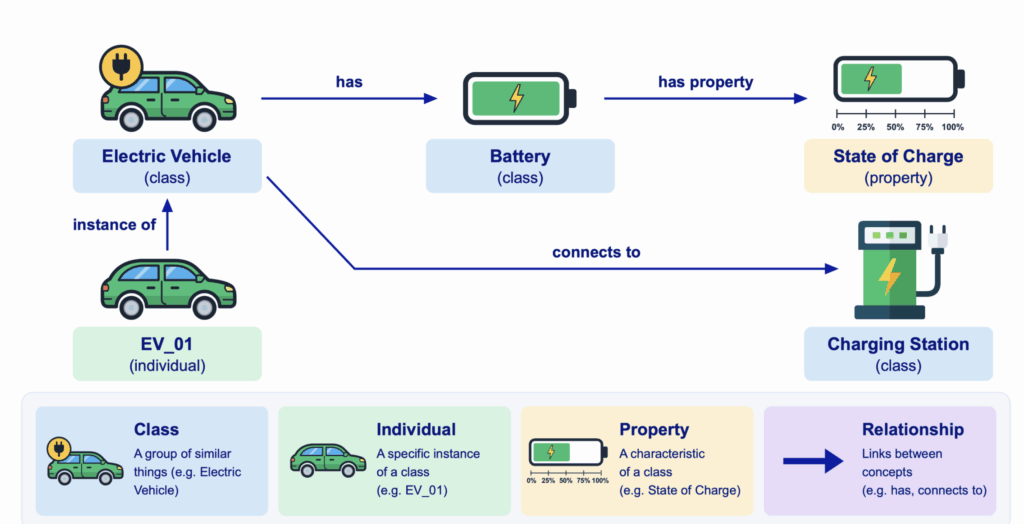
Figure 1. Illustrative example of core elements represented in an ontology.
From Ontologies to Semantic Interoperability
For software to process ontology knowledge, it needs a machine-readable form, meaning a structure that software can interpret directly. RDF (Resource Description Framework) represents information as a graph of simple statements called triples. Each triple contains a subject (the thing being described), a predicate (the relationship or property) and an object (the related thing or value) [4]. RDF is standardized and recommended by the W3C (World Wide Web Consortium, abbreviated as W3C, a standardization organization that promotes compatibility among World Wide Web technologies and was founded by Tim Berners-Lee, who is also the creator of the Semantic Web). Figure 2 illustrates three RDF triples using the electric vehicle example introduced above, showing the class memberships of the vehicle and its battery and the relationship between them. OWL (Web Ontology Language) is an ontology language that provides formally defined ways to describe classes, properties, individuals and logical relationships [5].
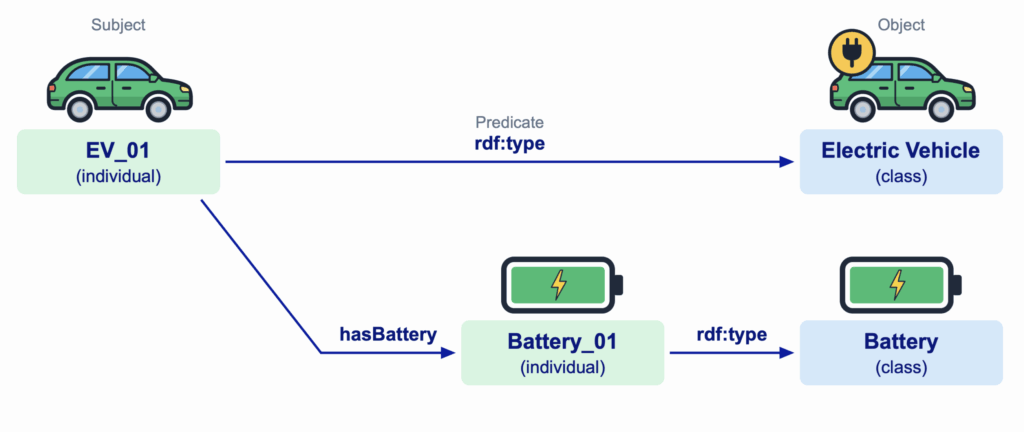
Figure 2. RDF graph illustrating three subject–predicate–object triples for an electric vehicle and its battery.
Different systems may represent the same kind of information in different ways. Returning to the power example, System A may represent it as Power = 7000 W, System B as Power = 7 kW, and System C as Power = 7, Unit = kW. For a combined representation such as Power=7kW, a parsing step separates the numerical value (7) from the unit (kW). Unit conversion can then be applied when necessary, for example converting 7000 W to 7 kW. However, these representations can be treated as equivalent only if they refer to the same kind of power and relevant measurement context.
Predefined mapping rules can then associate the extracted information with concepts and properties in a shared ontology, producing a common RDF representation of the power measurement, including its numerical value (7) and unit (kW). RML (RDF Mapping Language) provides a way to define mappings from structured data sources to RDF [6]. Parsing and unit conversion require explicit transformation logic, either before mapping or through supported functions. When systems use different ontologies, ontology alignment can establish correspondences between their concepts and properties, provided their meanings are compatible [7]. RDF and OWL provide the semantic representation but do not perform these transformations automatically. Figure 3 illustrates this process.
Together, these steps support semantic interoperability, meaning that different systems can exchange information while preserving a common understanding of what it means, not only its format. ISO/IEC 21823-3 addresses the use of ontologies for semantic interoperability in Internet of Things (IoT) systems [8]. Formal ontology relationships can also support reasoning, where software derives additional information from facts and relationships already represented [5].
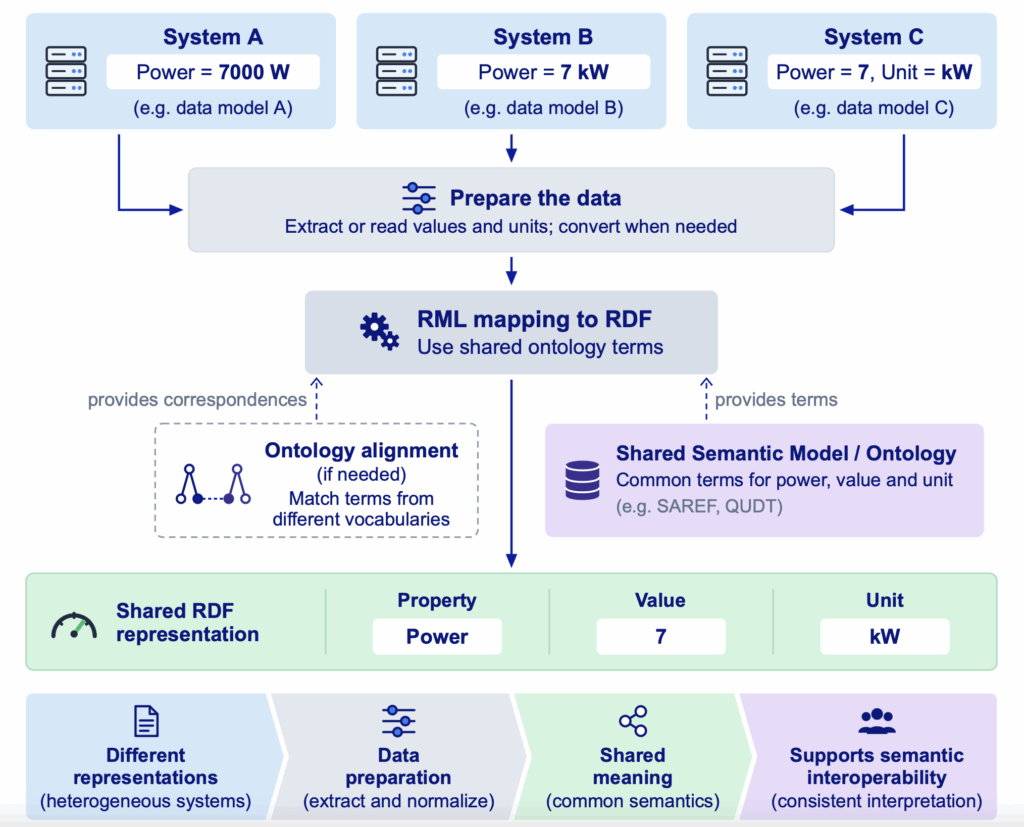
Figure 3. Different representations of power information mapped to a shared semantic meaning.
Ontologies in Smart Energy Systems
The need for shared meaning is particularly visible in smart energy, where grids, smart meters, renewable generation, batteries, buildings, heat pumps, energy management systems and electric vehicles increasingly interact. These systems may come from different domains and providers and use different data models even when they describe related energy information.
A concrete example is SAREF (Smart Applications REFerence ontology), a shared reference model for describing smart applications. The initiative started in 2014/2015 with a European Commission-requested study of existing semantic assets, meaning standards, protocols, data models and ontologies used to describe smart appliances. Around 50 assets were identified, recurring concepts were used as initial building blocks, and SAREF was published as ETSI TS 103 264 in November 2015 [9].
Today, SAREF is a suite of ETSI open standards intended to support semantic interoperability across providers and sectors. Its core ontology defines concepts that are broadly reusable, while domain extensions add concepts for areas such as energy, buildings, automotive and smart grids [9]. SAREF complements communication and control technologies by making the meaning of exchanged information explicit. Figure 4 illustrates this concept through a smart energy ecosystem in which different systems can be described using a shared semantic model, such as SAREF Core and its relevant domain extensions.
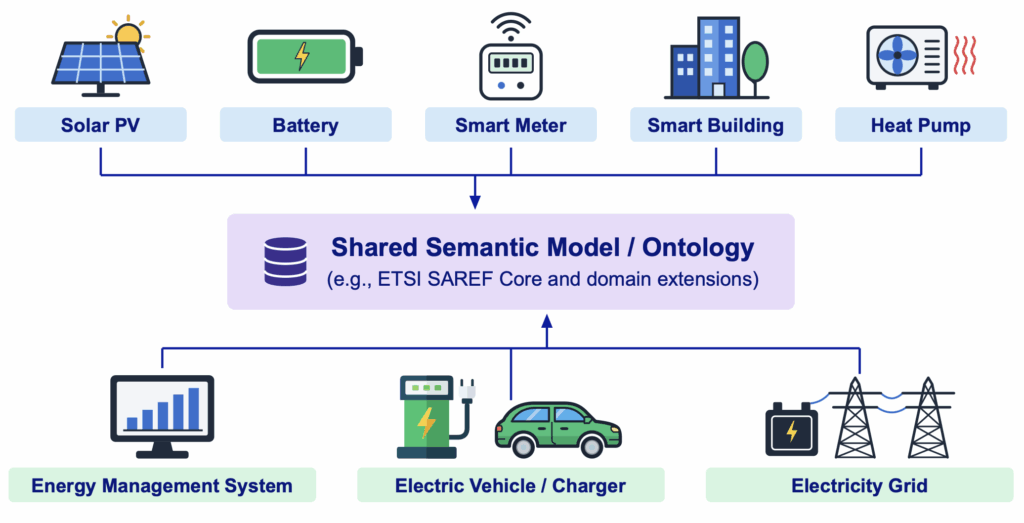
Figure 4. Conceptual representation of a shared semantic layer across a smart energy ecosystem.
Ontologies in E-Mobility: A Smart Charging Example
Electric vehicles provide a clear example because charging connects the mobility and energy domains. ISO 15118 is a family of standards for communication between an electric vehicle and charging equipment [10]. OCPP (Open Charge Point Protocol) standardizes communication between charging stations and central management systems [11]. These technologies define how information is exchanged at their interfaces, while ontologies address the complementary question of what that information means across systems and data models.
Figure 5 illustrates a smart-charging scenario in which an EV arrives home at 18:00 with a State of Charge (SOC) of 30%, and the user requires an SOC of 80% by 07:00 the following morning. Relevant information may come from the EV, charger, user requirements, building demand, local generation and the energy system. These inputs need consistent meanings for concepts such as Battery, State of Charge, Charging Power and Time.
An ontology can provide that shared semantic representation. An energy management or optimization system can then use the semantically described information when determining a charging strategy. The ontology describes what the information means; optimization and control components remain responsible for deciding and executing the charging action.
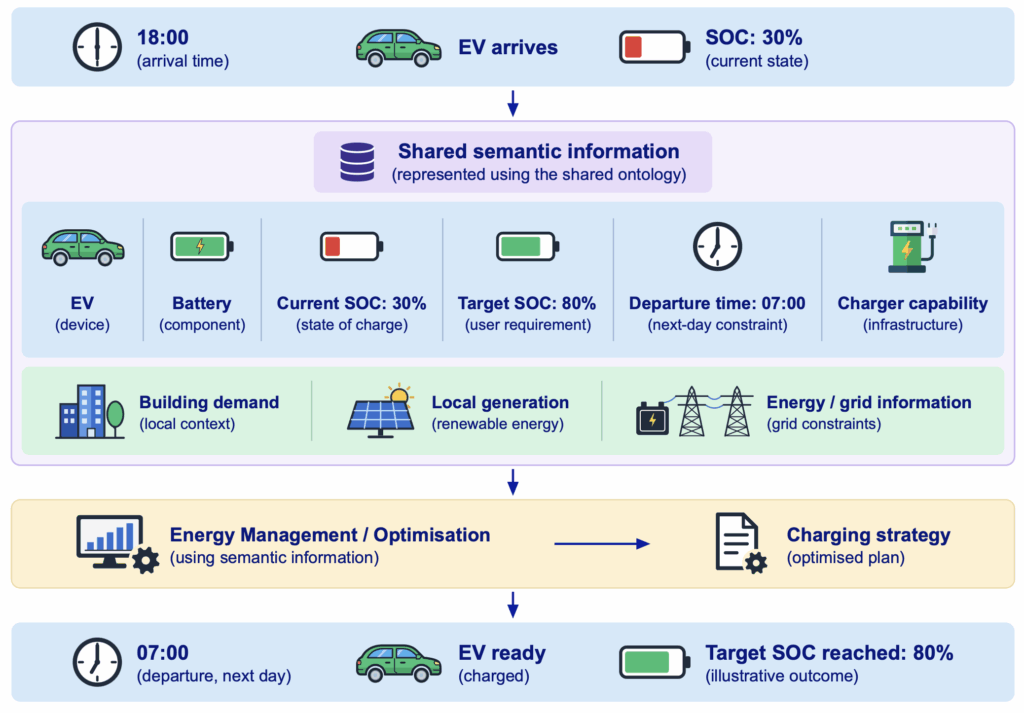
Figure 5. Illustrative smart-charging scenario showing how semantically described information can support an energy management application.
What Value Do Ontologies Bring?
Across these examples, ontologies provide shared meaning, help integrate information from different systems, and allow domain concepts to be reused. Because the knowledge is machine-processable, software can query it, meaning retrieve information based on defined concepts and relationships, and can use reasoning where appropriate [3][8].
Ontology-based models can also support validation, meaning checking whether data follows defined requirements. At Trialog, this principle is applied through the Ontology-Driven Constraint (ODC) Tester [12]. It combines ontology mapping with SHACL (Shapes Constraint Language) [13], a language standardized and recommended by the W3C for validating RDF graphs against defined conditions, and produces conformance reports showing whether the selected requirements are satisfied.
As energy systems become increasingly connected, exchanging data is only part of the interoperability challenge. Ontologies provide a shared semantic foundation that helps heterogeneous systems preserve and use the meaning of information across smart energy and e-mobility applications.
References
- Gruber, T. R. Toward Principles for the Design of Ontologies Used for Knowledge Sharing. International Journal of Human-Computer Studies, 43(5–6), 907–928, 1995. Source
- W3C Recommendation. OWL 2 Web Ontology Language: Document Overview (Second Edition). Source
- Noy, N. F. and McGuinness, D. L. Ontology Development 101: A Guide to Creating Your First Ontology. Stanford Knowledge Systems Laboratory, Technical Report KSL-01-05, Stanford University, 2001. Source
- W3C Recommendation. RDF 1.1 Concepts and Abstract Syntax. Source
- W3C Recommendation. OWL 2 Web Ontology Language: Structural Specification and Functional-Style Syntax (Second Edition). Source
- RDF Mapping Language (RML). Source
- Euzenat, J. and Shvaiko, P. Ontology Matching, 2nd Edition. Springer, 2013. Source
- ISO/IEC 21823-3:2021. Internet of things (IoT) — Interoperability for IoT systems — Part 3: Semantic interoperability. Source
- ETSI. A Brief History of SAREF / Smart Applications REFerence Ontology. Source
- ISO 15118-1:2019. Road vehicles — Vehicle to grid communication interface — Part 1: General information and use-case definition. Source
- Open Charge Alliance. OCPP Protocols. Source
- Ontology-Driven Constraint (ODC) Tester, Trialog. Source
- W3C Recommendation. Shapes Constraint Language (SHACL). Source