
Ontology-Driven Constraint (ODC) Tester
1. Overview
Stakeholders & Concerns
The Ontology-Driven Constraint (ODC) Tester is a technology-neutral, ontology-based interoperability testing solution developed by Trialog. It tests, assesses, and validates data against the selected relevant constraints. It was initially designed to verify that data from smart energy devices, energy management systems, and related platforms remain aligned with the reference ontologies defined within the European energy ecosystem. However, this tool will be extended to cover additional domains and needs, e.g., regulation and cybersecurity.
This work aligns with the European Commission’s Code of Conduct (CoC) for the interoperability of Energy Smart Appliances (ESA), coordinated by DG ENER and the Joint Research Centre (JRC). The CoC was launched on 23 April 2024 and sets a first milestone to place at least one interoperable ESA model on the market within 12 months of signature (for a 2024 signature, this typically implies a 2025 target), with broader uptake targeted by 2026 (e.g., most ESA models on the market).
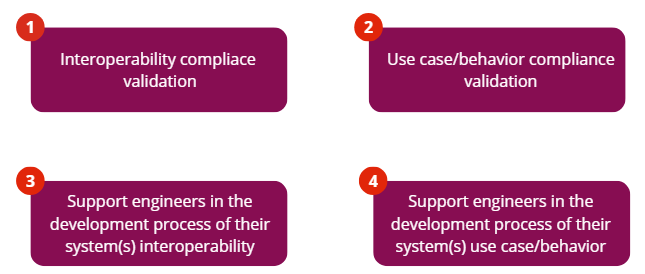
Together, semantic interoperability addresses what the data means, and behavioral interoperability addresses how systems act based on this meaning.
Benefits and Impact
By using the ODC-Tester, manufacturers, system integrators, and researchers can assess the semantic quality of appliance data, detect inconsistencies, and ensure that devices communicate according to European interoperability standards. With its ontology-based methodology and validation process, the tool delivers transparent, reliable, and repeatable testing results, helping accelerate interoperability, compliance, and innovation across the connected energy landscape.
Originally conceived and developed under the int:net project, the ODC-Tester marks a major advancement in ontology-based and technology-independent interoperability validation. Built first on the SAREF ontology (but not limited to it) and fully consistent with the JRC CoC for Energy Smart Appliances, the tool enables the testing, assessment, and validation of semantic interoperability across diverse systems and data models.
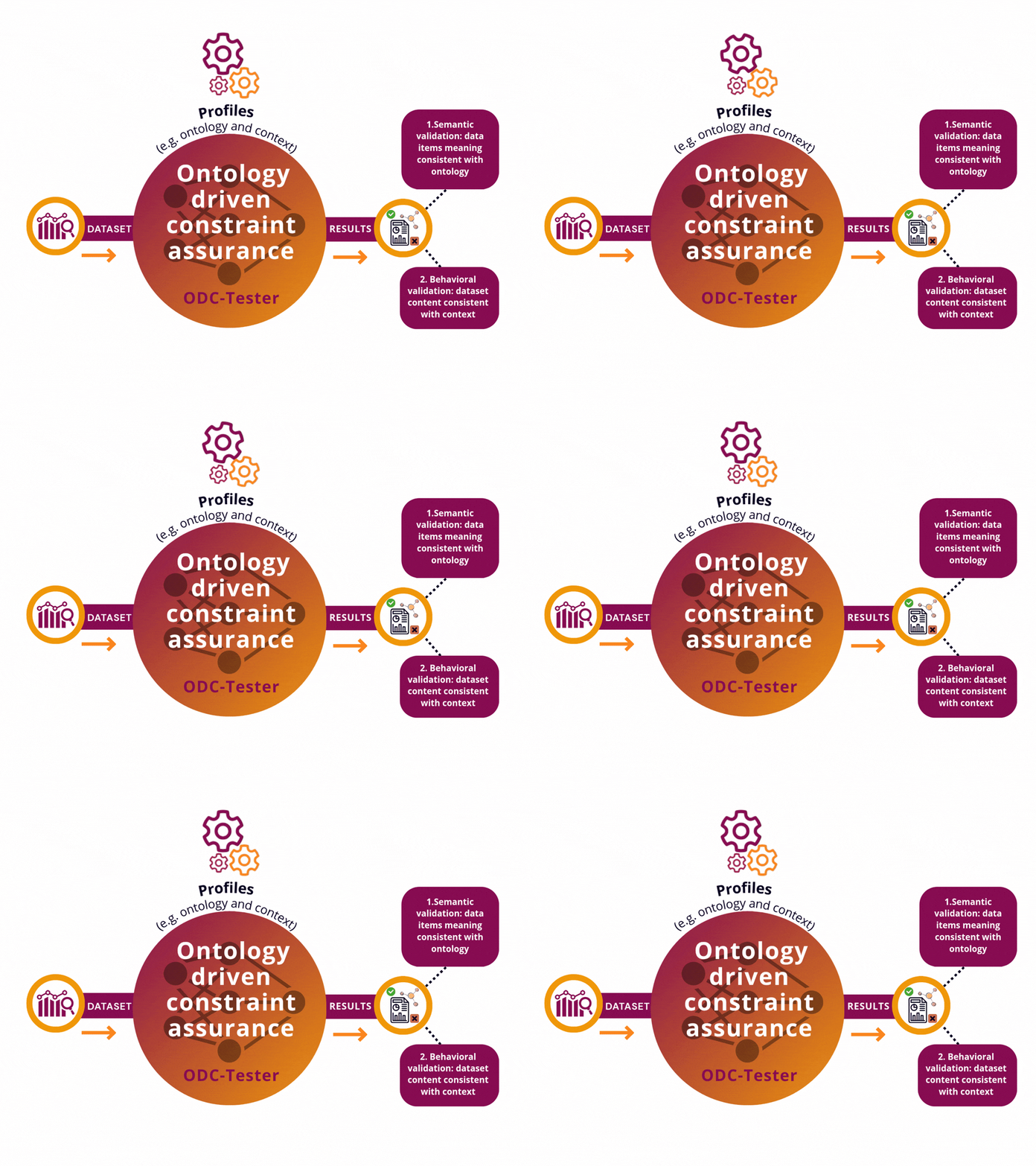
| The ODC-Tester methodology combines both ontology-based reasoning and a modular software architecture to deliver repeatable, scalable validation. It integrates ontology mapping, SHACL-based constraint checking, and automated compliance reporting to:
· Detect semantic inconsistencies in datasets · Validate ontology alignment against reference models · Generate detailed conformance and correction reports This process provides engineers and developers with a robust framework for ensuring data-level consistency and interoperability across heterogeneous systems. |
2. Two types of testing level: Semantic and Behavioral
Same tool, same engine,the input type determines which type of testing is applied.
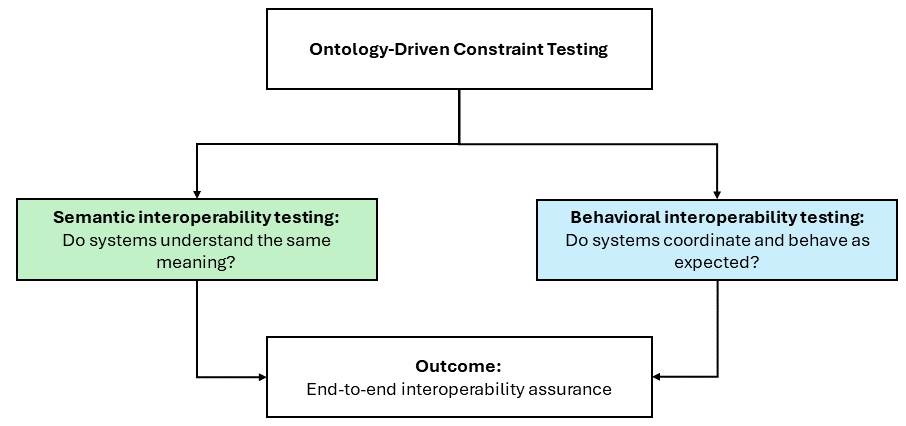
Figure : Overwiew of semantic and behavioral inteperoperability and their testing for end-to-assurance.
Semantic interoperability
According to the ISO/IEC 21823-3:2021 standard, semantic interoperability is defined as “interoperability so that the meaning of the data model within the context of a subject area is understood by the participating systems” [7]. Semantic interoperability means that systems share the same understanding of the data they exchange.
Semantic interoperability makes sure that all participating systems give the same meaning to the data they exchange. In an ontology and semantic web context, this means that systems rely on shared concepts and terms when they publish, consume and reason on data. Without this common meaning, the same value can be understood differently by different systems, and any later analysis becomes unreliable.
Behavior interoperability
According to the ISO/IEC 21823-5:2021 standard, behavioral interoperability is defined as “interoperability so that the actual result achieves the expected outcome” [8]. In the ontology and semantic web domain, behavioral interoperability means that systems use the same shared semantic descriptions not only to interpret exchanged data consistently, but also to trigger the expected actions so that the actual result matches the intended outcome during operation.
Behavioral interoperability evaluates how systems act on this shared meaning. Even if the data is interpreted in the same way, systems can still apply different control rules, timing choices, or policies and produce different outcomes for the same input. Behavioral interoperability focuses on these observable actions and checks that they remain consistent with functional goals, safety constraints, and regulatory rules when systems work together.

3. Operation
ODC Tester input
ODC-Tester takes as input datasets exported from an appliance or energy management system under test, typically provided as JSON, XML, or CSV. For execution, the test run is also configured with the target interoperability profile (for example, a SAREF-based use-case profile), the versioned constraint set (SHACL shapes and rules), and, when needed, mapping rules used to convert the source format into RDF for validation.
ODC Tester output
ODC-Tester generates a conformance assessment report that combines profile-level compliance status (PASS/FAIL and coverage/completeness indicators for the selected ontology profile) with fine-grained validation evidence (SHACL violations, severity levels such as Violation, affected RDF nodes, and properties). Outputs are delivered as a human-readable report. In practice, users select a profile (ontology subset, additional constraints), provide a dataset, run the pipeline (source to RDF transformation and SHACL/SPARQL constraint validation), and use the results to fix data quality issues, demonstrate profile conformance, or compare releases. The reporting layer can also generate result visualizations (pie charts) to provide a quick, interpretable view of validation outcomes.
4. Developments and Evolution
The work carried out within int:net laid a solid foundation for the tool’s success by defining its core concept, architecture, and operational prototype, and by demonstrating the feasibility and value of ontology-driven testing for smart device ecosystems.

Since its initial development, the ODC-Tester has shown promising results and continues to evolve through European Commission funded projects, including HEDGE-IoT and O-CEI, which aim to raise its Technology Readiness Level (TRL) and broaden its role beyond the original int:net framework.
This progress runs in parallel with advancements in related fields such as energy, electromobility, digital twins, generative AI, and cybersecurity, enabling the same ontology-based methodology to be reused across multiple sectors, not just smart appliances.
5. Future Development and Roadmap
Ongoing work focuses on extending the ODC-Tester to support behavioral testing and validation with real-world datasets, enabling comprehensive semantic (static) and behavior (dynamic) compliance assessment. These enhancements further reinforce its technological relevance and position the ODC-Tester as a key enabler for standardization and industrial adoption in future interoperability testing frameworks.
6. Collaboration (in the context of JRC)
The ODC-Tester is developed in alignment with the JRC Code of Conduct for Energy Smart Appliances and its associated interoperability testing needs. Trialog contributes by translating CoC requirements and use-case profiles into testable, versioned validation assets (profiles, constraints, and reporting structures) and by validating the approach on controlled simulated datasets (later on real manufacturer datasets). The collaboration also supports a continuous feedback loop: results from testing are used to clarify profile boundaries, improve constraint quality, and strengthen the practical applicability of the CoC across heterogeneous implementations.
7. Publications and Presentations
-
- Chy, T. Md Rabiul Hossain, Lamboro, H. M., Genest, O., Kung, A., Rabrait, C., Sebilleau, D., & Gyrard, A. (2025). Design of an Ontology-Driven Constraint Tester (ODCT) and Application to SAREF and Smart Energy Appliances. In Knowledge Graphs and Semantic Web (pp. 183–198). Springer.
- Energy Smart Appliances: launch of an EU Code of Conduct for interoperability (23 April 2024)
- SAREF ontology (Smart Applications REFerence ontology). ETSI portal: “SAREF ontology – ETSI” (development, history, extensions)
-
Chy, T. Md Rabiul Hossain, Bouter, C. , Daniele, L., Kung, A., Genest, O., Lamboro, H. M., Cornec, L., Rabrait, C. and Gyrard, A. (2026) Toward integration of Behavioral and Semantic Interoperability Testing in Energy Data Spaces. In the Fourth International Workshopon Semantics in Dataspaces (SDS 2026).

the European Union