

Smart energy systems rely on interactions among heterogeneous devices, energy management systems, energy data spaces, grid operators, service providers and digital platforms. In such distributed environments, interoperability requires more than just exchanging information. Systems must share a common understanding of that information and, when they interact, produce the expected operational outcomes. This challenge is at the core of Trialog’s research on semantic and behavioral interoperability.
Initial work on semantic interoperability led to the development of the Ontology-Driven Constraint (ODC) Tester, a proof-of-concept solution for validating data against shared ontologies and constraints. However, semantic conformance alone does not show whether systems behave as expected during operation. Correctly understood information can still lead to incorrect state changes, timing, action sequences or outcomes. The HEDGE-IoT project has extended this research to behavioral interoperability testing. This approach relates expected system behavior to observed execution evidence and evaluates whether interactions satisfy defined behavioral conditions and achieve the intended operational outcome.
A presentation on the interoperability of energy data spaces
During the “Use Cases Lightning Talks #1” session, Tareq Md Rabiul Hossain Chy, an engineer at Trialog, presented a joint paper by Trialog and TNO:
“Toward the Integration of Behavioral and Semantic Interoperability Tests in Energy Data Spaces”
This work was conducted as part of the HEDGE-IoT project, in collaboration with Cornelis Bouter and Laura Daniele at TNO, and with Antonio Kung, Olivier Genest, Henon Mengistu Lamboro, Léo Cornec, Cécile Rabrait, and Amélie Gyrard at Trialog.
As part of the HEDGE-IoT project, Trialog also specified a test suite for the Flexible Start use case of the Code of Conduct for Energy Smart Appliances (CoC ESA); the CoC ESA was developed by the European Commission’s Joint Research Centre (JRC). This test suite specification formalises the compliance tests applicable to the Flexible Start use case, covering the preconditions and Protocol Implementation Conformance Statement (PICS), the test procedures, the semantic and behavioral interoperability tests, and their verdict rules.
The team proposes to advance interoperability validation methods. Currently, tests often verify whether two systems exchange understandable and compliant data. The work presented here goes further: It verifies whether the systems exhibit the expected behavior when they interact.
Semantic interoperability is not always sufficient
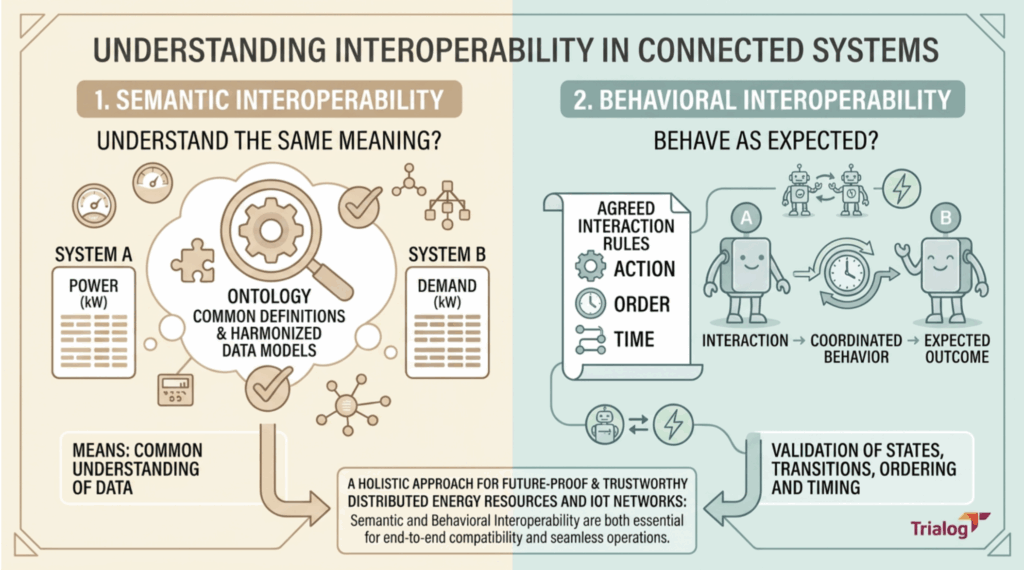
Semantic interoperability ensures that systems have a common understanding of the information they exchange. For example, two systems may agree on the meaning of data, such as
- the power consumed by an item of equipment,
- the operational status of a device,
- an operating time window,
- a request for energy flexibility.
This shared understanding is essential. Without it, data may be technically transmitted, but misinterpreted or used inconsistently. However, semantic alignment alone does not guarantee that systems will actually coordinate as intended. Data may be correctly understood, yet the behavior following the exchange may not comply with established rules.
Let’s take a simple example: A system receives a request to adjust the operation of a device. It understands the instruction but does not modify its behavior within the expected time frame. On paper, the exchange works. In practice, the flexibility service fails to fulfil its objective. Tests must therefore answer two questions:
- Do the systems exchange relevant, compliant, and correctly interpreted data?
- Do they respond as expected when the interaction takes place?
Three complementary dimensions according to the ISO/IEC 21823 series
To structure their approach, the work draws on the interoperability framework defined by the ISO/IEC 21823 series of standards, to which Trialog actively contributes.
ISO/IEC 21823-1: The various aspects of interoperability
The ISO/IEC 21823-1 Internet of Things (IoT) – Interoperability for IoT systems – Part 1: Framework standard offers a comprehensive view of interoperability. It distinguishes several complementary dimensions
- transport,
- syntax,
- semantics,
- behavior,
- and policies.
This classification takes us beyond a limited view of interoperability. Two systems must not only be able to communicate; they must also understand the same information, comply with applicable rules, and coordinate their actions.
ISO/IEC 21823-3: Sharing a common understanding of data
The ISO/IEC 21823-3 Internet of Things (IoT) – Interoperability for IoT systems – Part 3: Semantic interoperability standard focuses on semantic interoperability. It aims to ensure that the information exchanged is interpreted consistently by different systems. This standard plays a particularly important role in energy data spaces. Data often comes from different sources, with differing models, vocabularies and architectures that are not identical. By sharing a common semantics, stakeholders reduce the risk of divergent interpretations.
ISO/IEC 21823-5: Verifying what systems actually do
The ISO/IEC 21823-5 Internet of things – Interoperability for IoT systems – Part 5: Behavioural and policy interoperability standard complements this approach with behavioral interoperability and policies.
Note: The ISO/IEC 21823-5 standard currently has the status of ‘draft international standard’.
Here, teams do not merely verify whether an interaction was understood. They also observe its outcome: Did the system perform the correct action? Did it meet the deadlines? Did it follow the correct sequence? Did it reach the expected final state?
This approach addresses the needs of distributed energy systems. A single interaction can trigger multiple actions: activating equipment, modifying consumption, changing a state, or meeting a time constraint. Tests must be able to track this chain of events.
An ontology-based testing framework
The joint contribution by Trialog and TNO proposes an ontology-based testing framework. This approach supplements semantic interoperability tests with behavioral interoperability tests.
In practice, the framework does not merely verify the quality of the exchanged data. It also examines what happens during execution. It can take into account
- time constraints,
- transitions between different states,
- interaction sequences,
- expected operational results,
- execution traces produced by the systems.
This approach extends the Ontology-Driven Constraint (ODC) Tester to behavioral interoperability testing. A proof of concept has now been implemented for Scenario 3 of the Flexible Start use case. Leveraging the Behavioral Interoperability Testing Ontology (BITO) to represent scenarios, expected behaviors, observed execution evidence, validation results and verdicts.
From a technical standpoint, this validation relies on
- RDF (Resource Description Framework), to represent data and knowledge,
- verifications based on SHACL (Shapes Constraint Language) and SPARQL (SPARQL Protocol and RDF Query Language),
- the analysis of execution traces,
- and the generation of validation reports.
Combining these technologies aligns the formal description of systems more closely with their actual behavior in operation.
AI-generated image
Use case: Modifying the operation of a dishwasher
To illustrate their approach, the researchers selected a use case involving energy flexibility management.
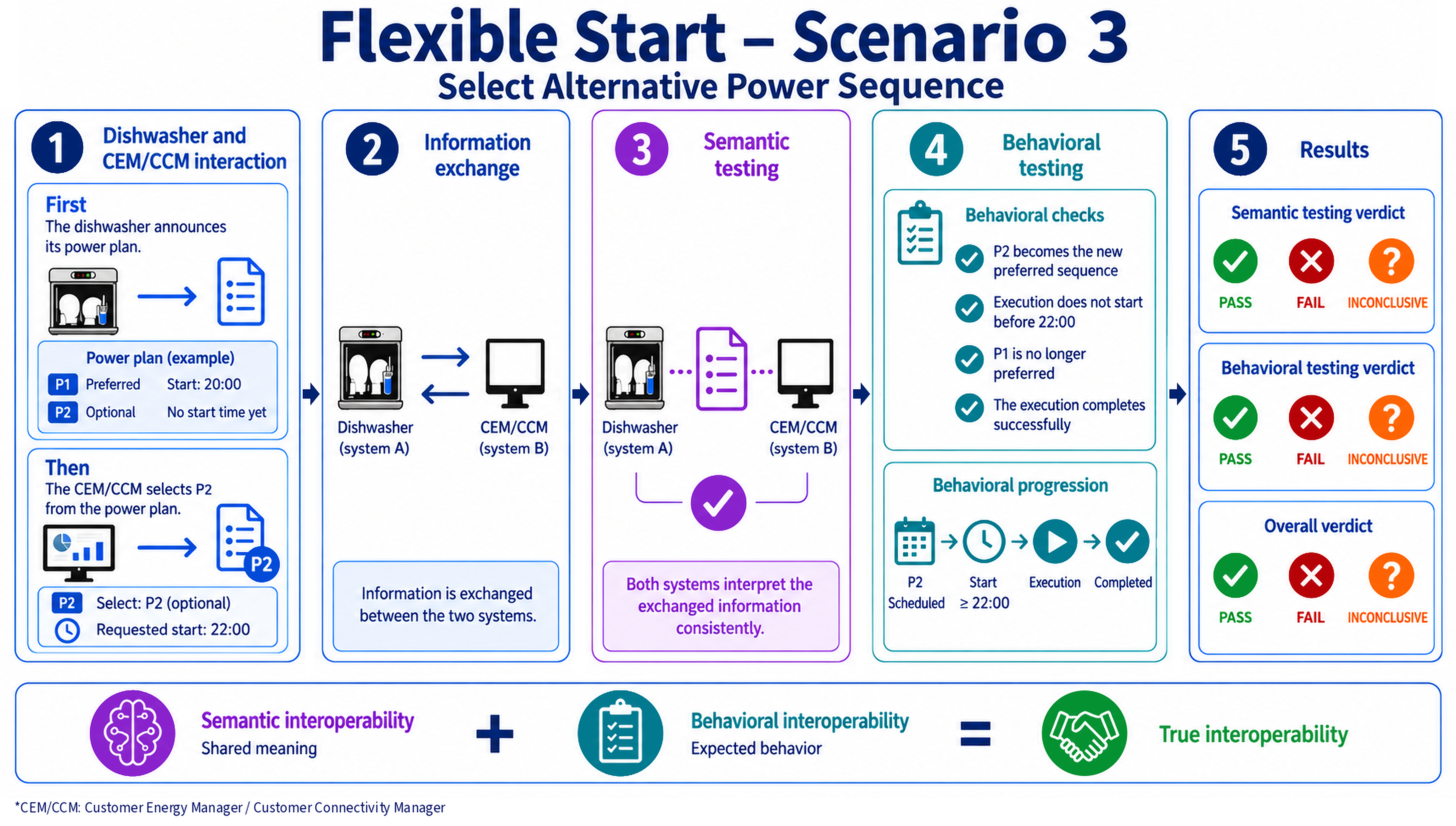
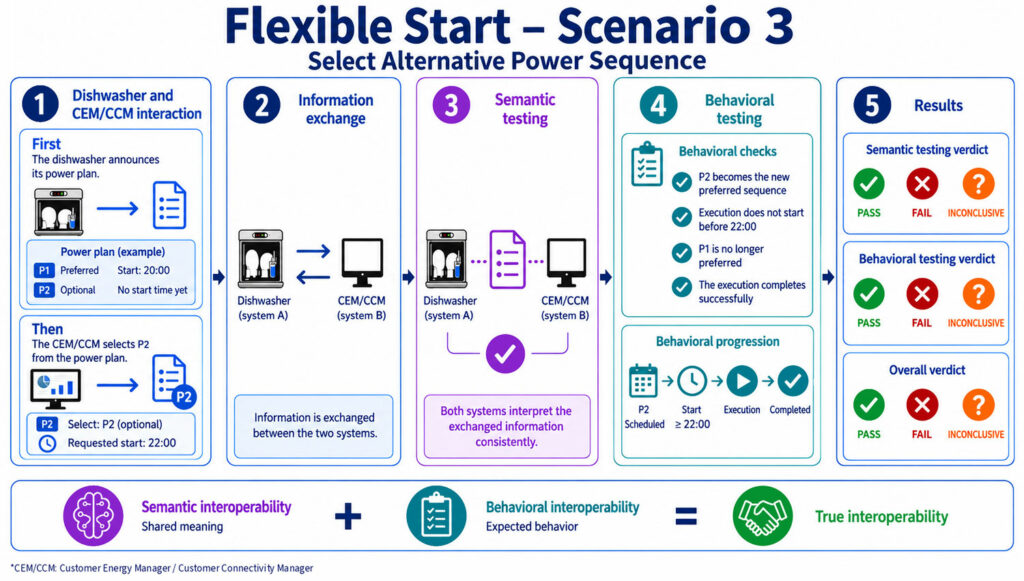
This scenario is based on the JRC’s CoC ESA. It focuses on the Flexible Start use case, scenario 3: the selection of an alternative power-on sequence for a dishwasher.
The dishwasher announces a preferred sequence P1 (8:00 p.m.–9:30 p.m.) and an alternative sequence P2 (10:00 p.m.–11:30 p.m.). A user may request P2, but only if the request is received before 8:00 p.m. After this deadline, the dishwasher rejects the request and sticks with P1.
If the request is accepted, four behavioral criteria must be verified:
- Does the dishwasher successfully enter the standby state for P2?
- Does it start its cycle at 10:00 p.m. ± 1 minute?
- Does it complete its cycle before 11:30 p.m.?
- Does its final state confirm completion?
AI-generated image.
This use case demonstrates the limitations of validation focused solely on data. To ensure a reliably flexible service, teams must observe, test and demonstrate the behavior of the systems involved. In the proof of concept, this logic is translated into validation rules that successively verify preconditions, acceptance, and state transitions, followed by compliance with temporal constraints and the observed final result.
Toward more reliable and interoperable energy systems
This paper opens up an important perspective for connected energy systems and energy data spaces. It proposes moving beyond a conception of interoperability that relies solely on exchanged data to incorporate the operational dimension.
An interoperable system should not only be capable of receiving and understanding information. It should also be able to respond as expected, comply with applicable constraints, and produce the intended result.
This ability to test and demonstrate behaviors can help strengthen
- trust among stakeholders in a data space,
- the reliability of energy services,
- the quality of system integrations,
- the reproducibility of validations,
- and the ability to identify discrepancies between expected and observed behavior.
This type of approach could facilitate the deployment of more automated, flexible, and coordinated energy services.
Since ‘Toward the Integration of Behavioural and Semantic Interoperability Tests in Energy Data Spaces’ was presented at SDS 2026, this work has reached a new milestone with the implementation of an initial proof of concept for behavioral interoperability testing on Scenario 3 of the Flexible Start use case. This implementation operationalises the proposed approach by combining BITO (Behavioral Interoperability Testing Ontology), observed execution evidence, RML mappings, RDF graphs, and SHACL/SPARQL validation rules to produce traceable behavioral results and verdicts.
The artefacts associated with this proof of concept are available in the HEDGE-IoT GitHub repository. They include the BITO ontology, input data and execution evidence, RML mappings, RDF graphs, SHACL/SPARQL validation rules, validation results and traces, and the technical documentation for the implementation. The implementation is also the subject of a follow-up scientific paper dedicated to the operationalisation and evaluation of the behavioral interoperability testing approach.
What are the next steps?
An initial proof of concept for Flexible Start Scenario 3 has been achieved, and the artefacts are available in the HEDGE-IoT repository. Future work will focus on validation using real-world systems, extension to other scenarios in the ESA CoC, scaling up, maturing the ODC Tester and policy interoperability.
Our current aim is to bring validation closer to real-world conditions by gradually relying on execution evidence from real systems. The work may also be extended to other scenarios and use cases relating to the JRC’s CoC ESA while assessing the approach’s ability to cover more complex behaviors, scale up and progressively increase the technological maturity of the ODC Tester.
More broadly, the team aims to contribute to the development of testing methods grounded in concrete evidence. These methods will help stakeholders demonstrate the reliability and interoperability of energy data spaces, rather than simply assuming them.
By linking semantics, behavior and operational validation, this paper advocates for a more comprehensive vision of interoperability: one in which systems not only understand each other but also demonstrate their ability to work together.
References
- Ontology-Driven Constraint (ODC) Tester
- Initial work on semantic interoperability (Zenodo)
- Scientific article on semantic and behavioural interoperability presented at the SDS 2026 workshop (ResearchGate)
- Proof of concept for behavioral interoperability testing – HEDGE-IoT GitHub
- Follow-up scientific article on behavioral interoperability: coming soon.