
CSR
Corporate Social Responsibility (CSR) refers to an organization’s voluntary integration of social, environmental, and ethical concerns into all its activities and its relationships with stakeholders. The goal of CSR is to create sustainable value, respect human rights, act responsibly, and contribute positively to sustainable development.
Trialog’s CSR approach is based on the international ISO 26000 standard, which provides a structured framework for integrating socially responsible practices into the company’s daily policies, processes, and actions. This standard is an internationally recognized benchmark for implementing a coherent and effective CSR strategy.
ISO 26000 identifies seven core CSR areas. Trialog relies on these pillars in structuring and evaluating its CSR policy.
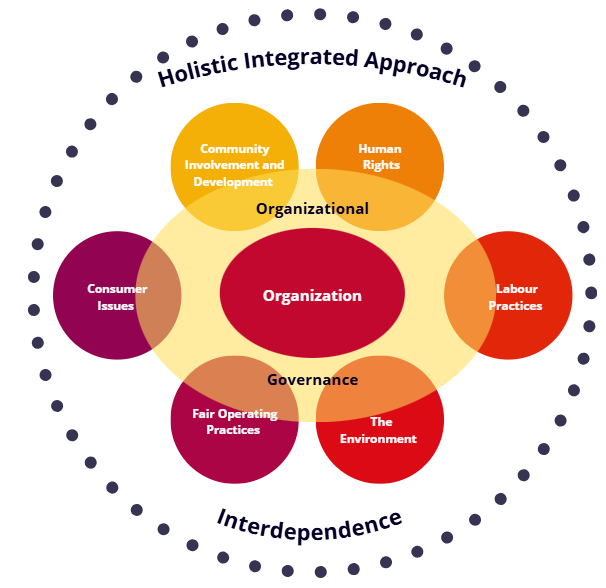
source image : https://www.iied.org/iso-26000-international-guidance-standard-social-responsibility
The ISO 26000 standard identifies seven core subjects that serve to structure and evaluate Corporate Social Responsibility actions. Trialog relies on these pillars to present and structure its CSR policy. Learn more: Discovering ISO 26000 – Guidance on social responsibility
Our CSR Pillars

Trialog places social responsibility at the heart of its governance to ensure that its decision-making processes are structured in a transparent, ethical, and participatory manner. The company's governance is based on a clear organization of responsibilities and strategic steering through internal mechanisms that promote consultation. Trialog's management team has embodied and transmitted these values since the company’s creation. Internal committees, such as the CSR Committee and the Well-Being Committee, allow volunteers to contribute to the company's reflections and orientations. These spaces for exchange contribute to the continual improvement of practices and the integration of societal issues into company decisions.

Trialog is committed to guaranteeing an inclusive, respectful, and equitable work environment through its Equality and Non-Discrimination Charter.
This charter is based on the core principles of human rights, including the Universal Declaration of Human Rights (December 10, 1948) and the European Convention on Human Rights (November 4, 1950). It applies to all company activities, particularly recruitment, career development, and compensation, which are based solely on skills and performance. It aims to ensure equal opportunity and prevent any form of discrimination. The charter is also part of Trialog’s Gender Equality Plan.

The well-being and development of employees are priorities for Trialog. The company provides a pleasant and friendly work environment, as well as flexible working conditions, including teleworking, to help its employees balance professional and personal life.
Trialog's Security unit is responsible for risk prevention. It operates throughout the year, notably by organizing internal training, conducting regular safety checks, and maintaining the Occupational Risk Assessment Document.
Trialog raises awareness of musculoskeletal disorders (MSDs) among its employees and provides ergonomic equipment suitable for both office work and teleworking.

Since 2019, Trialog has been estimating the company's carbon emissions internally based on the GoodPlanet Foundation methodology, inspired by the ADEME recommendations. Thus, Trialog is able to identify its main CO2-emitting sectors, which allows for the prioritization of CSR actions. This voluntary approach is a continuation of Trialog's activities in support of the energy transition.
The company takes concrete action by limiting emissions related to air travel, reducing waste through selective sorting, adopting low-consumption equipment, and raising employee awareness of eco-responsible practices.

In all its activities, Trialog ensures strict compliance with current legislation, particularly regulations regarding competition in France, Europe, and internationally. To guarantee transparency and fair practice, rules for interactions with customers and suppliers are regularly reviewed during internal training sessions. Trialog's attentive management is available to examine any situation that may seem inappropriate and take the necessary measures.

Trialog provides its clients with clear and reliable information about its services and contracts. The company is also committed to ensuring responsive after-sales service and high-quality support in the maintenance and monitoring of its solutions. Trialog pays special attention to data protection and information confidentiality, which helps strengthen trust in its business relationships.

Trialog is committed to promoting inclusion and diversity within the organization. The company collaborates with ESAT Jean Moulin, a medico-social establishment that supports people with disabilities, and it entrusts certain missions to hearing-impaired workers.
Trialog implements initiatives, such as French Sign Language training, to facilitate the integration of hearing-impaired workers and promote fluid communication throughout the organisation. This approach contributes to job creation and employee retention.